Development of a Low-Alloy Steel Stress-Strain Curve Simulation Model Using the Ramberg-Osgood Approach
DOI:
https://doi.org/10.67795/ijomest.v1i1.15Keywords:
Low-alloy steel, stress-strain curve, ramberg-Osgood, strain hardening exponent, material simulationAbstract
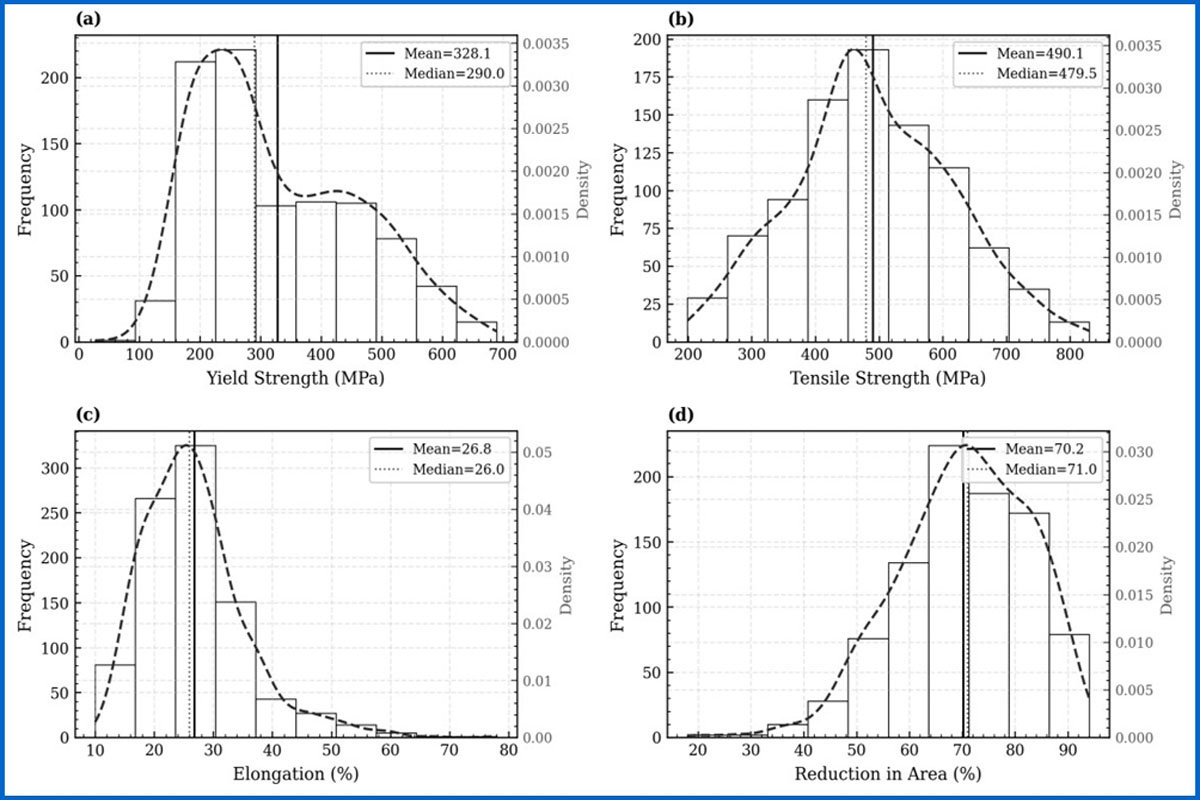
The stress-strain curve is essential information in the analysis of material mechanical behavior; however, obtaining the curve directly requires specialized testing that is not always available. On the other hand, standard tensile test parameters such as yield strength, tensile strength, elongation, and reduction in area are commonly available from routine material testing. This study addresses this condition by developing a low-alloy steel stress-strain curve simulation model based on the Ramberg-Osgood equation using these four mechanical parameters as the primary inputs. The main parameter in this model is the strain hardening exponent (n), which is calculated directly from the available mechanical data. The calculated n values ranged from 1.992 to 38.211, with an average value of 14.17, which is consistent with the general characteristics of low-alloy steels. The simulated curves exhibited profiles consistent with the behavior of ductile metals, where each specimen produced different plastic deformation characteristics according to its respective mechanical properties. Internal validation demonstrated that the simulated curves showed complete agreement with the mechanical input parameters, without deviation across all analyzed samples. The results indicate that low-alloy steel stress-strain curves can be accurately reconstructed using only conventional tensile test data. Therefore, the developed model has the potential to serve as a practical solution for generating stress-strain curves when complete experimental curve data are unavailable but required for further engineering analysis.
References
Fang, Q., Zhao, L., Chen, C., Zhu, Y., Peng, Y., & Yin, F. (2023). Effect of heat input on microstructural and mechanical properties of high strength low alloy steel block parts fabricated by wire arc additive manufacturing. Materials Today Communications, 34, 105146.
Leni, D. (2023). Prediction Modeling of Low Alloy Steel Based on Chemical Composition and Heat Treatment Using Artificial Neural Network. Jurnal Polimesin, 21(5), 54-61.
Leni, D., Sumiati, R., Angelia, N., & Nofriyanti, E. (2023). The Influence of Heatmap Correlation-based Feature Selection on Predictive Modeling of Low Alloy Steel Mechanical Properties Using Artificial Neural Network (ANN) Algorithm. Journal of Energy, Material, and Instrumentation Technology, 4(4), 152-162.
Ispir, M., Ates, A. O., & Ilki, A. (2022, April). Low strength concrete: Stress-strain curve, modulus of elasticity and tensile strength. In Structures (Vol. 38, pp. 1615-1632). Elsevier.
American Society of Mechanical Engineers. (2021). ASME boiler and pressure vessel code, section VIII, division 2: Alternative rules for construction of pressure vessels. ASME.
European Committee for Standardization. (2005). Eurocode 3: Design of steel structures, EN 1993-1-1: General rules and rules for buildings. CEN.
Veeman, D., Jeevaraj, K., Das, M. M., Arumugaperumal, P., & Subramaniyan, M. K. (2025). Generation of Stress–Strain Curve for Additively Fabricated Structure by Ramberg–Osgood Model: A Comparative Study. Journal of Materials Engineering and Performance, 1-10.
Ganesan, M., Devarajan, V. M., Veeman, D., & Subramaniyan, M. K. (2026). Stress–Strain Plots for Fabricated Dissimilar Metal Additive Walls by Ramberg–Osgood Equation. Journal of Materials Engineering and Performance, 1-12.
Kujawski, D., Patwardhan, P. S., & Nalavde, R. A. (2020). An estimation of true Ramberg‐Osgood curve parameters for materials with and without Luder's strain using yield and ultimate strengths. Fatigue & Fracture of Engineering Materials & Structures, 43(9), 2147-2156.
Marohnić, T., Basan, R., & Marković, E. (2023). Estimation of Cyclic Stress–Strain Curves of Steels Based on Monotonic Properties Using Artificial Neural Networks. Materials, 16(14), 5010.
Veeman, D., Yang, R., Jeevaraj, K., Das, M. M., Arumugaperumal, P., & Subramaniyan, M. K. (2025). Ramberg–Osgood-Based Stress–Strain Curve Generation Using Tensile Yield/Strength for Additively Manufactured Stainless Steel. Journal of Materials Engineering and Performance, 1-10.
Abdullatef, A. D., Ali, S. I., Aldarraji, S. Y. H., & Ali, M. I. (2026). Evaluating the Ramberg–Osgood Model for nonlinear moment–curvature analysis of reinforced concrete beams.
Nemer, S. (2023). Verification of the Ramberg-Osgood Material Model for the Fire Design of Steel Members. Slovak Journal of Civil Engineering, 31(2), 9-15.
Kong, H. (n.d.). MatNavi mechanical properties of low-alloy steels [Dataset]. Kaggle. https://www.kaggle.com/datasets/konghuanqing/matnavi-mechanical-properties-of-lowalloy-steels.
ASTM International. (2017). ASTM E111-17: Standard test method for Young's modulus, tangent modulus, and chord modulus. ASTM International. https://doi.org/10.1520/E0111-17.
Ramberg, W., & Osgood, W. R. (1943). Description of stress-strain curves by three parameters. Technical Note No. 902, National Advisory Committee for Aeronautics.
ASTM International. (2022). ASTM E8/E8M-22: Standard test methods for tension testing of metallic materials. ASTM International. https://doi.org/10.1520/E0008_E0008M-22.
Dieter, G. E. (1986). Mechanical metallurgy (3rd ed.). McGraw-Hill.
Kamaya, M. (2016). Ramberg–Osgood type stress–strain curve estimation using yield and ultimate strengths for failure assessments. International Journal of Pressure Vessels and Piping, 137, 1-12.
James, L. A. (1995). Ramberg-Osgood strain-hardening characterization of an ASTM A302-B steel.
Callister Jr, W. D., & Rethwisch, D. G. (2020). Materials science and engineering: an introduction. John wiley & sons.
Dieter, G. E., & Bacon, D. (1976). Mechanical metallurgy (Vol. 3, pp. 43-53). New York: McGraw-hill.
Downloads
Published
Issue
Section
License
Copyright (c) 2026 Yuda Perdana Kusuma, Nasrullah, Hooi Peng Lim, Muchlisinalahuddin, Muhammad Rabiu Abbas

This work is licensed under a Creative Commons Attribution 4.0 International License.