Analysis of the Effect of Fused Deposition Modeling Process Parameters on the Tensile Strength of PLA Material
DOI:
https://doi.org/10.67795/ijomest.v1i1.16Keywords:
Fused Deposition Modeling, Ultimate Tensile Strength, Process Parameters, Layer Height, Build AngleAbstract
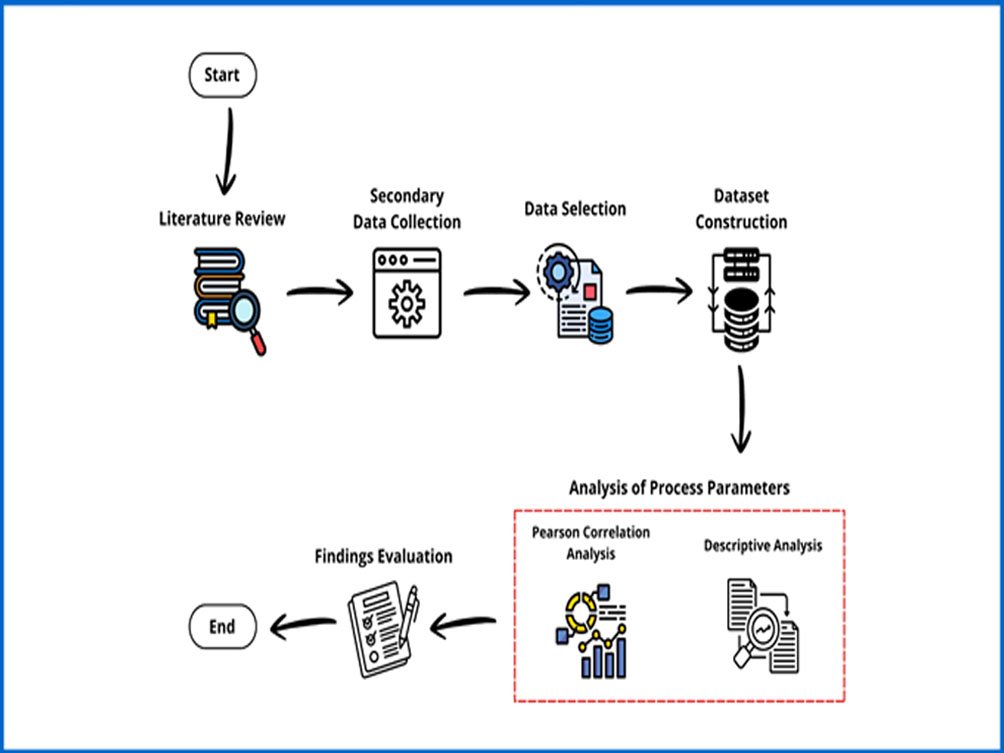
Variations in process parameters in Fused Deposition Modeling (FDM) often lead to differences in the tensile strength of Polylactic Acid (PLA) materials. However, results reported in previous studies remain inconsistent and difficult to compare directly. This condition makes it challenging to identify which parameters have a truly significant effect on tensile strength. This study aims to analyze the influence of FDM process parameters on the tensile strength of PLA materials using secondary data consisting of 74 observations, which were organized into a structured dataset and analyzed using descriptive statistics and correlation analysis. The results show that print orientation has the strongest negative correlation, with a value of −0.51, indicating that an increase in print orientation is associated with a decrease in tensile strength. Layer height also shows a negative correlation of −0.38, where smaller layer thickness is associated with higher tensile strength. Nozzle temperature exhibits a positive correlation of 0.35, while print speed does not show a significant effect on ultimate tensile strength (UTS). This approach enables a faster and more systematic identification of the most influential parameters compared to reviewing individual studies separately. Therefore, this study provides a clearer understanding of parameter prioritization in the FDM process, which can support more efficient decision-making to improve the tensile strength of PLA materials.
References
Ahn, S. H., Montero, M., Odell, D., Roundy, S., & Wright, P. K. (2002). Anisotropic material properties of fused deposition modeling ABS. Rapid Prototyping Journal, 8(4), 248–257.
Kafshgar, A. R., Rostami, S., Aliha, M. R. M., & Berto, F. (2021). Optimization of properties for 3D printed PLA material using Taguchi, ANOVA and multi-objective methodologies. Procedia Structural Integrity, 34, 71–77.
Patil, S., Murkute, R., Shirgaokar, A., & Kamat, M. (2021). Multi-objective optimization of process parameters of fused deposition modeling (FDM) for printing polylactic acid (PLA) polymer components. Materials Today: Proceedings, 46, 4310–4318.
Bembenek, M., Kowalski, Ł., & Kosoń-Schab, A. (2022). Research on the influence of processing parameters on the specific tensile strength of FDM additive manufactured PET-G and PLA materials. Polymers, 14(12), 2446.
Cojocaru, V., Frunza, G., Vladut, V., & Biris, S. (2022). The influence of the process parameters on the mechanical properties of PLA specimens produced by fused filament fabrication — A review. Sustainability, 14(3), 1988.
Marșavina, L., Vălean, C., Mărghitaș, M., Linul, E., Razavi, N., Berto, F., & Brighenti, R. (2022). Effect of the manufacturing parameters on the tensile and fracture properties of FDM 3D-printed PLA specimens. Engineering Fracture Mechanics, 274, 108766.
Ambade, V., Rajurkar, S., Awari, G., Yelamasetti, B., & Shelare, S. (2025). Influence of FDM process parameters on tensile strength of parts printed by PLA material. International Journal on Interactive Design and Manufacturing (IJIDeM), 19(1), 573-584.
Jatti, V. S., Tamboli, S., Shaikh, S., Solke, N. S., Gulia, V., Jatti, V. S., ... & Abouel Nasr, E. S. (2024). Optimization of tensile strength in 3D printed PLA parts via meta-heuristic approaches: a comparative study. Frontiers in Materials, 10, 1336837.
Tuncel, Ö. (2024). Optimization of Charpy impact strength of tough PLA samples produced by 3D printing using the Taguchi method. Polymer Testing, 130, 108309.
Leni, D. (2023). Pemilihan Algoritma Machine Learning Yang Optimal Untuk Prediksi Sifat Mekanik Aluminium. Jurnal Engine: Energi, Manufaktur, dan Material, 7(1), 35–44.
Diana, L., Safitra, A. G., & Ariansyah, M. N. (2020). Analisis kekuatan tarik pada material komposit dengan serat penguat polimer. Jurnal Engine: Energi, Manufaktur, dan Material, 4(2), 59-67.
Suzen, Z. S., & Hasdiansah, H. (2021). Pengaruh Geometri Infill terhadap Kekuatan Tarik Spesimen Uji Tarik ASTM D638 Type IV Menggunakan Filamen PLA+ Sugoi. Jurnal Rekayasa Mesin, 16(2), 140-147.
Schober, P., Boer, C., & Schwarte, L. A. (2018). Correlation coefficients: appropriate use and interpretation. Anesthesia & analgesia, 126(5), 1763-1768.
Leni, D., Earnestly, F., Sumiati, R., Adriansyah, A., & Kusuma, Y. P. (2023). Evaluasi sifat mekanik baja paduan rendah bedasarkan komposisi kimia dan suhu perlakuan panas menggunakan teknik exploratory data analysis (EDA). Dinamika Teknik Mesin, 13(1), 74-83.
Torrado, A. R., Shemelya, C. M., English, J. D., Lin, Y., Wicker, R. B., & Roberson, D. A. (2015). Characterizing the effect of additives to ABS on the mechanical property anisotropy of specimens fabricated by material extrusion 3D printing. Additive Manufacturing, 6, 16-29.
Sood, A. K., Ohdar, R. K., & Mahapatra, S. S. (2010). Parametric appraisal of mechanical property of fused deposition modelling processed parts. Materials & Design, 31(1), 287–295.
Tymrak, B. M., Kreiger, M., & Pearce, J. M. (2014). Mechanical properties of components fabricated with open-source 3-D printers under realistic environmental conditions. Materials & Design, 58, 242–246.
Megersa, G. K., Sitek, W., Nowak, A. J., & Tomašić, N. (2024). Investigation of the influence of fused deposition modeling 3D printing process parameters on tensile properties of polylactic acid parts using the Taguchi method. Materials, 17(23), 5951.
Tünçay, M. M. (2024). An investigation of 3D printing parameters on tensile strength of PLA using response surface method. Journal of Materials Engineering and Performance, 33(12), 6249-6258.
Hong Vi, N., Chuong, C. K. B., My, L. T. T., Hieu, D. H. M., & Thanh, T. T. (2022, November). Effects of Infill Density, Layer Thickness and Raster Angle on Weight and Tensile Strength of PLA Products Fabricated by Fused Deposition Modeling (FDM). In International Conference on Material, Machines and Methods for Sustainable Development (pp. 87-98). Cham: Springer Nature Switzerland.
Cojocaru, V., Frunzaverde, D., Miclosina, C. O., & Marginean, G. (2022). The influence of the process parameters on the mechanical properties of PLA specimens produced by fused filament fabrication A review. Polymers, 14(5), 886.
Downloads
Published
Issue
Section
License
Copyright (c) 2026 Desmarita Leni, Yazmendra Rosa, Eka Sunitra, Riza Muharni, Yuanda Perdana Kusuma

This work is licensed under a Creative Commons Attribution 4.0 International License.