Numerical Analysis of Pressure and Velocity Distribution on NACA 0012 Airfoil Using Two CFD Computational Domains
DOI:
https://doi.org/10.67795/ijomest.v1i1.18Keywords:
NACA 0012, CFD, pressure coefficien, flow separation, vortexAbstract
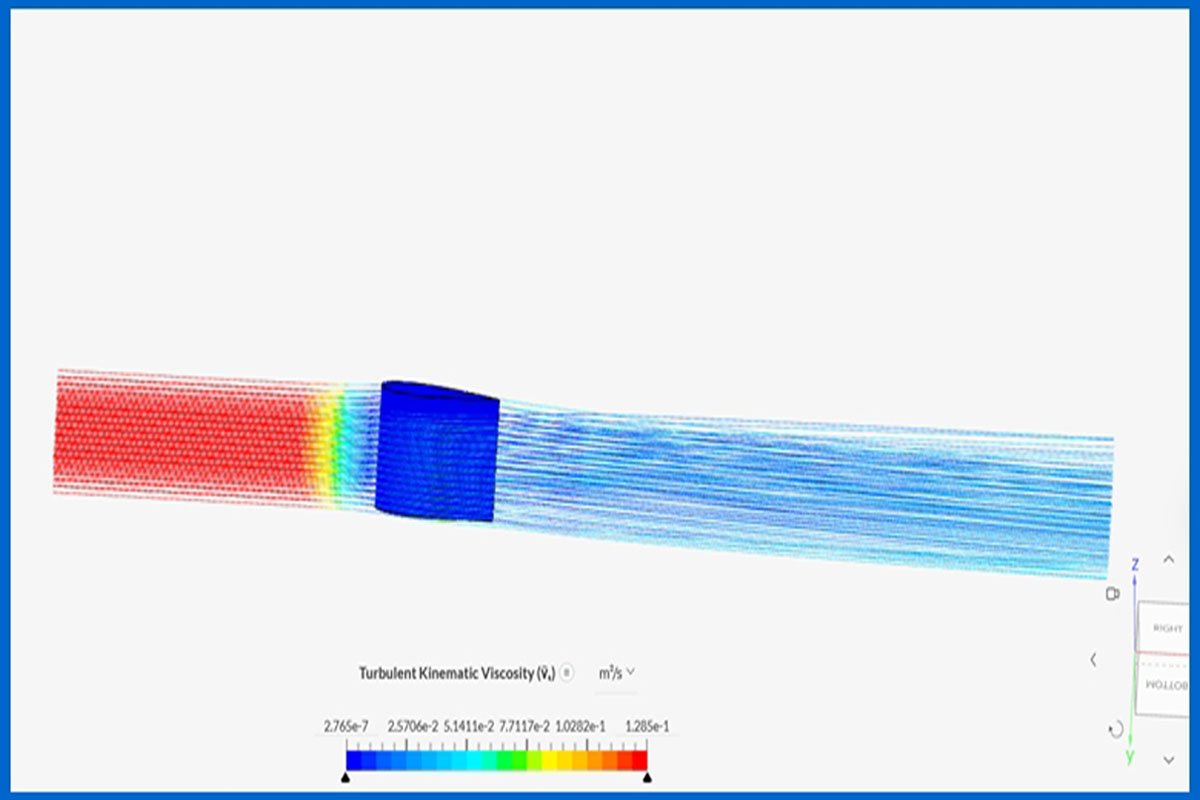
The NACA 0012 airfoil is widely applied in aeronautics, wind turbines, and unmanned aerial vehicles (UAVs). This study investigates the pressure and velocity distributions on a NACA 0012 airfoil at a 5° angle of attack using two computational domain configurations in Computational Fluid Dynamics (CFD): a block domain and a tilted-airfoil domain. Simulations were conducted in OpenFOAM using a steady-state incompressible solver with the k-ω SST turbulence model and SIMPLE algorithm at an inlet velocity of 16 m/s (Re ≈ 1.1×10⁶). The computational mesh consisted of 482,700 cells and 157,100 nodes. Validation against experimental and numerical references showed good agreement, with pressure coefficient deviations below 5%. The results indicate a significant negative pressure gradient on the upper airfoil surface, maximum velocity reaching 16.15 m/s, and the presence of wake asymmetry and initial flow separation near the trailing edge. Differences in turbulent kinetic energy between the two configurations demonstrate that domain setup significantly influences turbulence development and aerodynamic prediction accuracy. This study highlights the sensitivity of CFD simulations to computational domain configuration in airfoil aerodynamic analysis.
References
D Anderson, Fundamentals of Aerodynamics, 6th ed. New York: McGraw-Hill Education, 2017.
IH Abbott and AE Von Doenhoff, Theory of Wing Sections: Including a Summary of Airfoil Data. New York: Dover Publications, 1959.
FM White, Fluid Mechanics, 8th ed. New York: McGraw-Hill Education, 2016.
HK Versteeg and W. Malalasekera, An Introduction to Computational Fluid Dynamics: The Finite Volume Method, 2nd ed. Harlow: Pearson Education, 2007.
FR Menter, “Two-equation eddy-viscosity turbulence models for engineering applications,” AIAA Journal, vol. 32, no. 8, pp. 1598–1605, 1994.
MR Raciti Castelli, A. Englaro, and E. Benini, “The Darrieus wind turbine: Proposal for a new performance prediction model based on CFD,” Energy, vol. 36, no. 8, pp. 4919–4934, 2011.
CL Ladson, CW Brooks Jr., AS Hill, and DW Sproles, “Computer program to obtain ordinates for NACA airfoils,” NASA Technical Memorandum 4741, 1996.
DC Eleni, TI Athanasios, and MP Dionissios, “Evaluation of the turbulence models for the simulation of the flow over a National Advisory Committee for Aeronautics (NACA) 0012 airfoil,” Journal of Mechanical Engineering Research, vol. 4, no. 3, pp. 100–111, 2012.
PK Kundu and IM Cohen, Fluid Mechanics, 4th ed. Burlington: Academic Press, 2008.
DC Wilcox, Turbulence Modeling for CFD, 3rd ed. La Cañada: DCW Industries, 2006.
SB Pope, Turbulent Flows. Cambridge: Cambridge University Press, 2000.
T. Cebeci and J. Cousteix, Modeling and Computation of Boundary-Layer Flows, 2nd ed. Berlin: Springer, 2005.
MS Selig, JJ Guglielmo, AP Broeren, and P. Giguere, Summary of Low-Speed Airfoil Data, Vol. 1. Virginia Beach: SoarTech Publications, 1995.
S. Kumar and M. Selig, “Numerical investigation of trailing edge separation and reattachment on NACA 0012 at low Reynolds numbers,” Journal of Fluids Engineering, vol. 128, no. 4, pp. 765–772, 2006.
Y. Liu, L. Li, and Z. Chen, “Numerical study of pressure distribution and aerodynamic performance of NACA 0012 using k-ω SST turbulence model,” International Journal of Aerospace Engineering, vol. 2019, Article ID 5491464, 2019.
Downloads
Published
Issue
Section
License
Copyright (c) 2026 Yuni vadila, Rayhan Stevano, Randi Pernama Putra

This work is licensed under a Creative Commons Attribution 4.0 International License.