Corrosion Behavior of Ti-12Cr and Commercially Pure Titanium (CpTi) in AFNOR Artificial Saliva at 37°C
DOI:
https://doi.org/10.67795/ijomest.v1i2.22Keywords:
Ti-12Cr, commercially pure titanium (CpTi), , corrosion, AFNOR artificial saliva, orthodontic biomaterialsAbstract
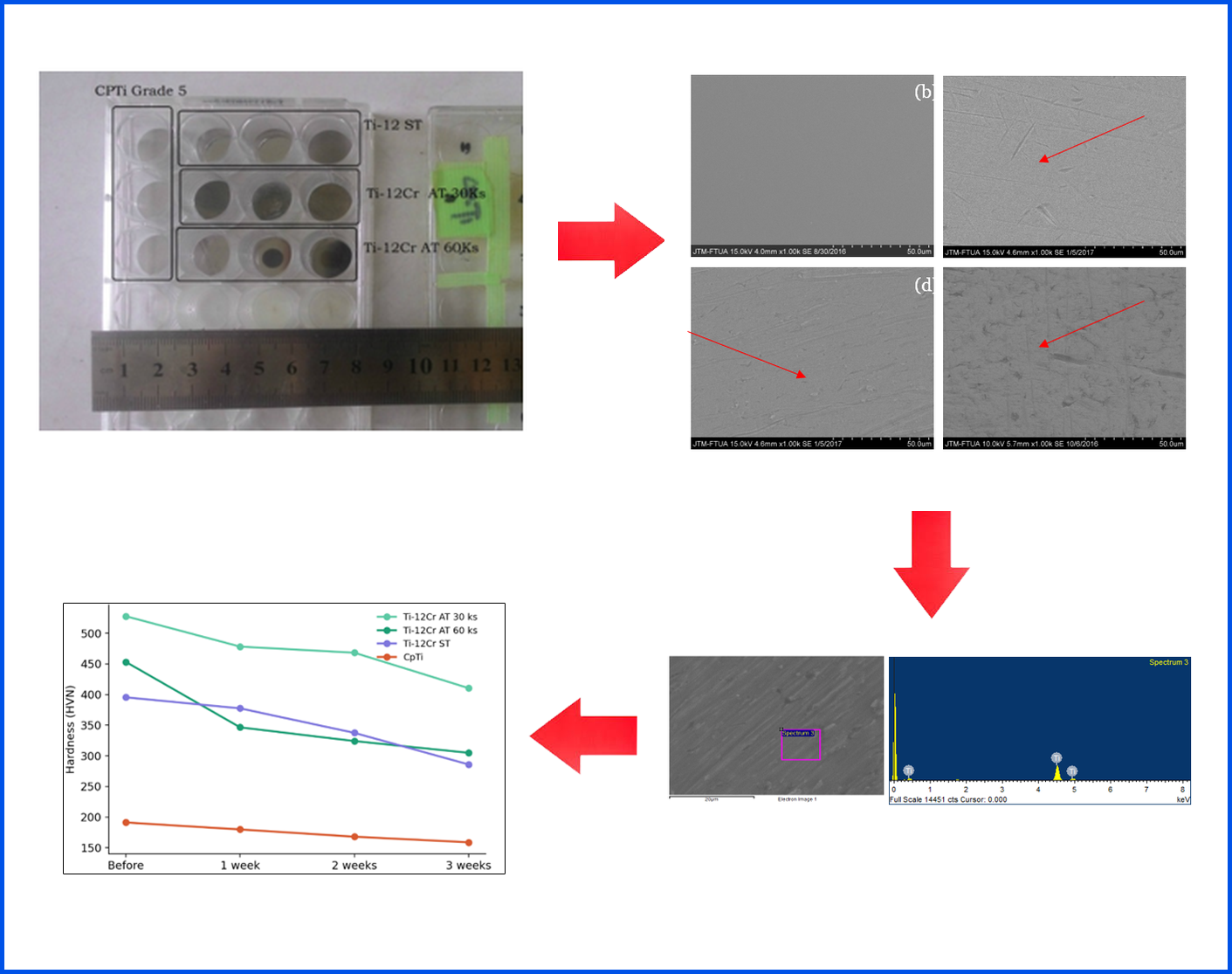
Metallic materials for orthodontic applications must exhibit good corrosion resistance, as they operate within the corrosive environment of the oral cavity. Titanium and its alloys are widely used as biomaterials owing to their favorable biocompatibility and corrosion resistance. This study aimed to evaluate the corrosion behavior of Ti-12Cr alloy under three heat-treatment conditions, namely solution treated (ST), aged for 30 ks (AT 30 ks), and aged for 60 ks (AT 60 ks), and to compare it with commercially pure titanium (CpTi) in AFNOR artificial saliva at 37°C. Corrosion testing was performed using the weight-loss method with immersion periods of 1, 2, and 3 weeks, using one specimen for each condition. Surface characterization was conducted using Scanning Electron Microscopy (SEM) and Energy Dispersive X-ray Spectroscopy (EDX), while the mechanical properties were evaluated through Vickers hardness testing before and after immersion. The results showed that all materials experienced weight loss during immersion. Ti-12Cr AT 60 ks exhibited the lowest average corrosion rate at 3.88 × 10⁻⁶ mmpy, followed by Ti-12Cr AT 30 ks at 4.18 × 10⁻⁶ mmpy and Ti-12Cr ST at 5.00 × 10⁻⁶ mmpy, whereas CpTi showed the highest corrosion rate at 7.70 × 10⁻⁶ mmpy. Hardness testing revealed a decline in hardness values for all materials during immersion, with Ti-12Cr AT 30 ks maintaining the highest hardness throughout the observation period. The findings indicate that Ti-12Cr possesses better corrosion resistance than CpTi, and that increasing the aging time from 30 ks to 60 ks resulted in a further reduction in the average corrosion rate. The Ti-12Cr AT 60 ks condition yielded the highest corrosion resistance, whereas Ti-12Cr AT 30 ks retained the highest hardness after immersion. These results reveal a divergence between the corrosion resistance and hardness responses to heat treatment. Overall, Ti-12Cr demonstrates potential as a nickel-free.
References
Y. Zhan et al., “Effects of orthodontic treatment on masticatory muscles activity: a meta-analysis,” Ann. Hum. Biol., vol. 50, no. 1, pp. 465–471, Jan. 2023, doi: 10.1080/03014460.2023.2271840.
J. Bącela, M. B. Łabowska, J. Detyna, A. Zięty, and I. Michalak, “Functional Coatings for Orthodontic Archwires—A Review,” Materials, vol. 13, no. 15, p. 3257, Jul. 2020, doi: 10.3390/ma13153257.
A. Fróis, A. C. Santos, and C. S. Louro, “Corrosion of Fixed Orthodontic Appliances: Causes, Concerns, and Mitigation Strategies,” Metals, vol. 13, no. 12, p. 1955, Nov. 2023, doi: 10.3390/met13121955.
I. Sifakakis and T. Eliades, “Adverse reactions to orthodontic materials,” Aust. Dent. J., vol. 62, no. S1, pp. 20–28, Mar. 2017, doi: 10.1111/adj.12473.
A. Amato, S. Martina, G. De Benedetto, A. Michelotti, M. Amato, and F. Di Spirito, “Hypersensitivity in Orthodontics: A Systematic Review of Oral and Extra-Oral Reactions,” J. Clin. Med., vol. 14, no. 13, p. 4766, Jul. 2025, doi: 10.3390/jcm14134766.
A. S. Hammood, A. F. Noor, and M. T. Alkhafagy, “Effect of heat treatment on corrosion behavior of duplex stainless steel in orthodontic applications,” Mater. Res. Express, vol. 4, no. 12, p. 126506, Dec. 2017, doi: 10.1088/2053-1591/aa9c02.
A. A. S. Begum, R. M. A. Vahith, M. K. V. Mohamed, V. Kotra, B. Shaik, and A. Al-Kahtani, “Corrosion mitigation on orthodontic wire made of SS 18/8 alloy using esomeprazole tablet (Esiloc-40 mg) in artificial saliva,” J. Saudi Chem. Soc., vol. 27, no. 4, p. 101681, Jul. 2023, doi: 10.1016/j.jscs.2023.101681.
M. H. Abd Ali, E. S. Al-Hassani, and F. J. Al-Hasani, “Improving Corrosion Resistance of Stainless Steel 316L, Titanium Orthodontic Archwires Enhanced by Metallic Coatings,” J. Phys. Conf. Ser., vol. 3028, no. 1, p. 012006, Jun. 2025, doi: 10.1088/1742-6596/3028/1/012006.
P. Močnik and T. Kosec, “A Critical Appraisal of the Use and Properties of Nickel–Titanium Dental Alloys,” Materials, vol. 14, no. 24, p. 7859, Dec. 2021, doi: 10.3390/ma14247859.
Q. Rao et al., “Research Progress of the Coatings Fabricated onto Titanium and/or Titanium Alloy Surfaces in Biomaterials for Medical Applications for Anticorrosive Applications,” Coatings, vol. 15, no. 5, p. 599, May 2025, doi: 10.3390/coatings15050599.
R. Zhang, B. Han, and X. Liu, “Functional Surface Coatings on Orthodontic Appliances: Reviews of Friction Reduction, Antibacterial Properties, and Corrosion Resistance,” Int. J. Mol. Sci., vol. 24, no. 8, p. 6919, Apr. 2023, doi: 10.3390/ijms24086919.
R. S. El-Kamel and A. M. Fekry, “Pepsin-driven corrosion of orthodontic titanium alloys in candidiasis-simulated saliva: electrochemical and statistical insights,” Sci. Rep., vol. 16, no. 1, p. 5937, Feb. 2026, doi: 10.1038/s41598-026-36707-8.
D. L. Buruiana, N. L. Bogatu, A. C. Muresan, E. E. Herbei, C. Trus, and V. Ghisman, “Evaluating the Impact of Artificial Saliva Formulations on Stainless Steel Integrity,” Appl. Sci., vol. 15, no. 10, p. 5345, May 2025, doi: 10.3390/app15105345.
M. Mangal, V. Grover, S. Sood, and A. Jain, “Metal ion release of titanium and titanium alloy dental implants with dissimilar abutment materials: A systematic review of in vitro studies,” J. Indian Soc. Periodontol., vol. 29, no. 3, pp. 230–240, May 2025, doi: 10.4103/jisp.jisp_76_25.
A. Bordbar-Khiabani, “Simulated Body Fluids for Dental Implant Corrosion: A Practical Guide,” Dent. J., vol. 14, no. 5, p. 292, May 2026, doi: 10.3390/dj14050292.
Obaid Muslem AL-Hajri, Lakkimsetty Nageswara Rao*, Shaik Feroz, “Study of Corrosion Rate in Water Treatment Plant in Oil field,” Int. J. Chem. Synth. Chem. React., vol. Vol. 3, no. Issue 1, doi: 10.37628/IJCSCR.
H.-C. Hsu, S.-C. Wu, C.-F. Wang, and W.-F. Ho, “Electrochemical behavior of Ti–Cr alloys in artificial saliva,” J. Alloys Compd., vol. 487, no. 1–2, pp. 439–444, Nov. 2009, doi: 10.1016/j.jallcom.2009.07.172.
S. Anderson, Annisa, J. Affi, Y. Yetri, and Gunawarman, “The Effect of Aging Treatment on Mechanical Properties And Microstructures of Ti-12Cr In Ortodontic Applications,” IOP Conf. Ser. Mater. Sci. Eng., vol. 846, no. 1, p. 012066, May 2020, doi: 10.1088/1757-899X/846/1/012066.
N. El-Bagoury et al., “The Influence of Microstructure on the Passive Layer Chemistry and Corrosion Resistance for Some Titanium-Based Alloys,” Materials, vol. 12, no. 8, p. 1233, Apr. 2019, doi: 10.3390/ma12081233.
M. A. Hussein, A. Madhan Kumar, A. F. Abdelaal, and M. Abdul Azeem, “Surface Analysis and In Vitro Corrosion Properties in Artificial Saliva of Surface-Treated Ti6Al4V Alloy for Dental Applications,” Metall. Mater. Trans. A, vol. 52, no. 9, pp. 4299–4309, Sep. 2021, doi: 10.1007/s11661-021-06387-2.
Downloads
Published
Issue
Section
License
Copyright (c) 2026 Aguswan Amirul Arif, Gunawarman Gunawarman, Jon Affi

This work is licensed under a Creative Commons Attribution 4.0 International License.