Development of Chitosan-Based Graphene Hydrogel for Efficient Solar Evaporation
DOI:
https://doi.org/10.67795/ijomest.v1i2.25Keywords:
Evaporation System, Hydrogel, Irradiation, Absorbent and Water, Mass LossAbstract
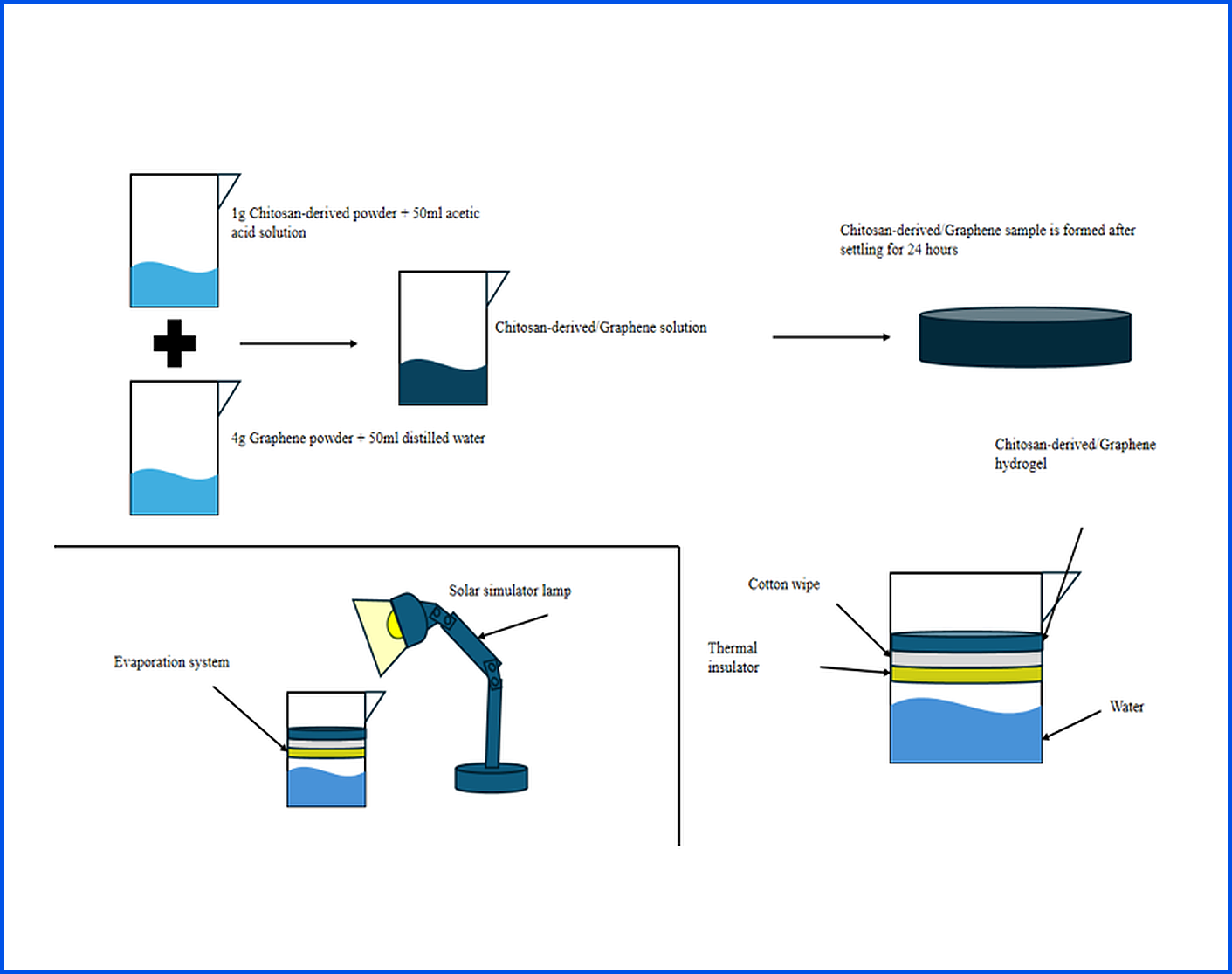
This study aims to evaluate the effectiveness of developing a chitosan-derived graphene hydrogel for a solar evaporation system. The hydrogel was prepared in two types, i.e. flat-surface and hemispherical-surface hydrogels. The system consisted of a chitosan-derived embedded graphene hydrogel, a cotton wipe, and a thermal insulator. The system was then tested using a solar simulator to investigate the effect of varying irradiation times from 1 to 12 hours. The morphology of the hydrogel was characterised using an inverted microscope before and after irradiation for 1 and 12 hours, respectively. The experimental test includes temperature distribution and water mass loss for the samples before and after irradiation for 1 and 12 hours. The resultant findings provide useful data on the evaporation system efficiency under the simulated conditions. It was reported that the hemispherical-surface hydrogel reached a lower temperature distribution of 52 °C than the flat-surface hydrogel at 57 °C. The water mass loss of the hemispherical-surface hydrogel is as low as -1.22 g, indicating a higher evaporation rate of 0.09205 kgm−2 h−1 than the flat-surface hydrogel of -1.48 g and 0.04568 kgm−2 h−1, respectively. This study reveals that a lower total water mass loss can occur alongside a higher evaporation rate when the surface area exposed to air is very small, as in a hemispherical-surface hydrogel.
References
C. Thambiliyagodage, M. Jayanetti, A. Mendis, G. Ekanayake, H. Liyanaarachchi, and S. Vigneswaran, “Recent advances in chitosan-based applications—A review,” Materials, vol. 16, no. 5, Art. no. 2073, Mar. 2023, doi: 10.3390/ma16052073.
M. Nasrollahzadeh, M. Sajjadi, S. Iravani, and R. S. Varma, “Starch, cellulose, pectin, gum, alginate, chitin and chitosan derived (nano)materials for sustainable water treatment: A review,” Carbohydr. Polym., vol. 251, Art. no. 116986, Jan. 2021, doi: 10.1016/j.carbpol.2020.116986.
Z. Feng, K. Odelius, and M. Hakkarainen, “Tunable chitosan hydrogels for adsorption: Property control by biobased modifiers,” Carbohydr. Polym., vol. 196, pp. 135–145, Sep. 2018, doi: 10.1016/j.carbpol.2018.05.029.
A. Narayanan, R. Kartik, E. Sangeetha, and R. Dhamodharan, “Super water absorbing polymeric gel from chitosan, citric acid and urea: Synthesis and mechanism of water absorption,” Carbohydr. Polym., vol. 191, pp. 152–160, Jul. 2018, doi: 10.1016/j.carbpol.2018.03.028.
Z. Feng, M. Hakkarainen, H. Grützmacher, A. Chiappone, and M. Sangermano, “Photocrosslinked chitosan hydrogels reinforced with chitosan-derived nano-graphene oxide,” Macromol. Chem. Phys., vol. 220, no. 13, Art. no. 1900174, 2019, doi: 10.1002/macp.201900174.
Y. H. Wang et al., “Evaluation of chitosan-based dressings in a swine model of artery-injury-related shock,” Sci. Rep., vol. 9, no. 1, Art. no. 14608, 2019, doi: 10.1038/s41598-019-51208-7.
Y. Xu, K. Sheng, C. Li, and G. Shi, “Self-assembled graphene hydrogel via a one-step hydrothermal process,” ACS Nano, vol. 4, no. 7, pp. 4324–4330, Jul. 2010, doi: 10.1021/nn101187z.
K. X. Sheng, Y. X. Xu, C. Li, and G. Q. Shi, “High-performance self-assembled graphene hydrogels prepared by chemical reduction of graphene oxide,” New Carbon Mater., vol. 26, no. 1, pp. 9–15, 2011, doi: 10.1016/S1872-5805(11)60062-0.
H. N. Lim, N. M. Huang, S. S. Lim, I. Harrison, and C. H. Chia, “Fabrication and characterization of graphene hydrogel via hydrothermal approach as a scaffold for preliminary study of cell growth,” Int. J. Nanomedicine, vol. 6, pp. 1817–1823, 2011, doi: 10.2147/IJN.S23392.
G. Sun, B. Li, J. Ran, X. Shen, and H. Tong, “Three-dimensional hierarchical porous carbon/graphene composites derived from graphene oxide-chitosan hydrogels for high performance supercapacitors,” Electrochim. Acta, vol. 171, pp. 13–22, Jul. 2015, doi: 10.1016/j.electacta.2015.05.009.
M. Zhu, X. Liu, Y. Tian, A. Caratenuto, F. Chen, and Y. Zheng, “Dome-arrayed chitosan/PVA hydrogel-based solar evaporator for steam generation,” Sci. Rep., vol. 12, no. 1, Art. no. 4403, Mar. 2022, doi: 10.1038/s41598-022-08589-z.
Z. Li et al., “Chitosan-derived carbon aerogel modified with lignin carbon quantum dots for efficient solar evaporation,” Chem. Eng. J., vol. 486, Art. no. 150157, Apr. 2024, doi: 10.1016/j.cej.2024.150157.
W. M. J. Karen, Z. Wang, W. Y. H. Liew, and G. J. H. Melvin, “Low-cost and sustainable carbonized sawdust based solar absorber for solar vapor generation towards seawater desalination,” Waste Biomass Valorization, vol. 14, no. 9, pp. 3071–3080, Sep. 2023, doi: 10.1007/s12649-023-02067-x.
W. M. J. Karen, C. Y. Wong, and G. J. H. Melvin, “Desalination of seawater using carbon-coated solar absorber in solar still,” IOP Conf. Ser. Mater. Sci. Eng., vol. 1217, no. 1, Art. no. 012001, 2022, doi: 10.1088/1757-899X/1217/1/012001.
F. Wang et al., “Chitosan/reduced graphene oxide-modified spacer fabric as a salt-resistant solar absorber for efficient solar steam generation,” J. Mater. Chem. A, vol. 7, no. 31, pp. 18311–18317, 2019, doi: 10.1039/C9TA05859A.
Downloads
Published
Issue
Section
License
Copyright (c) 2026 Hooi Peng Lim, Limi Chong, Ida Rosmanizan Abdullah

This work is licensed under a Creative Commons Attribution 4.0 International License.