Effect of Fillet Radius at the Shank-to-Body Transition on the Local and Global Structural Responses of a Lifting Hook
DOI:
https://doi.org/10.67795/ijomest.v1i2.29Keywords:
lifting hook, fillet radius, finite element method, von-Mises stress, factor of safetyAbstract
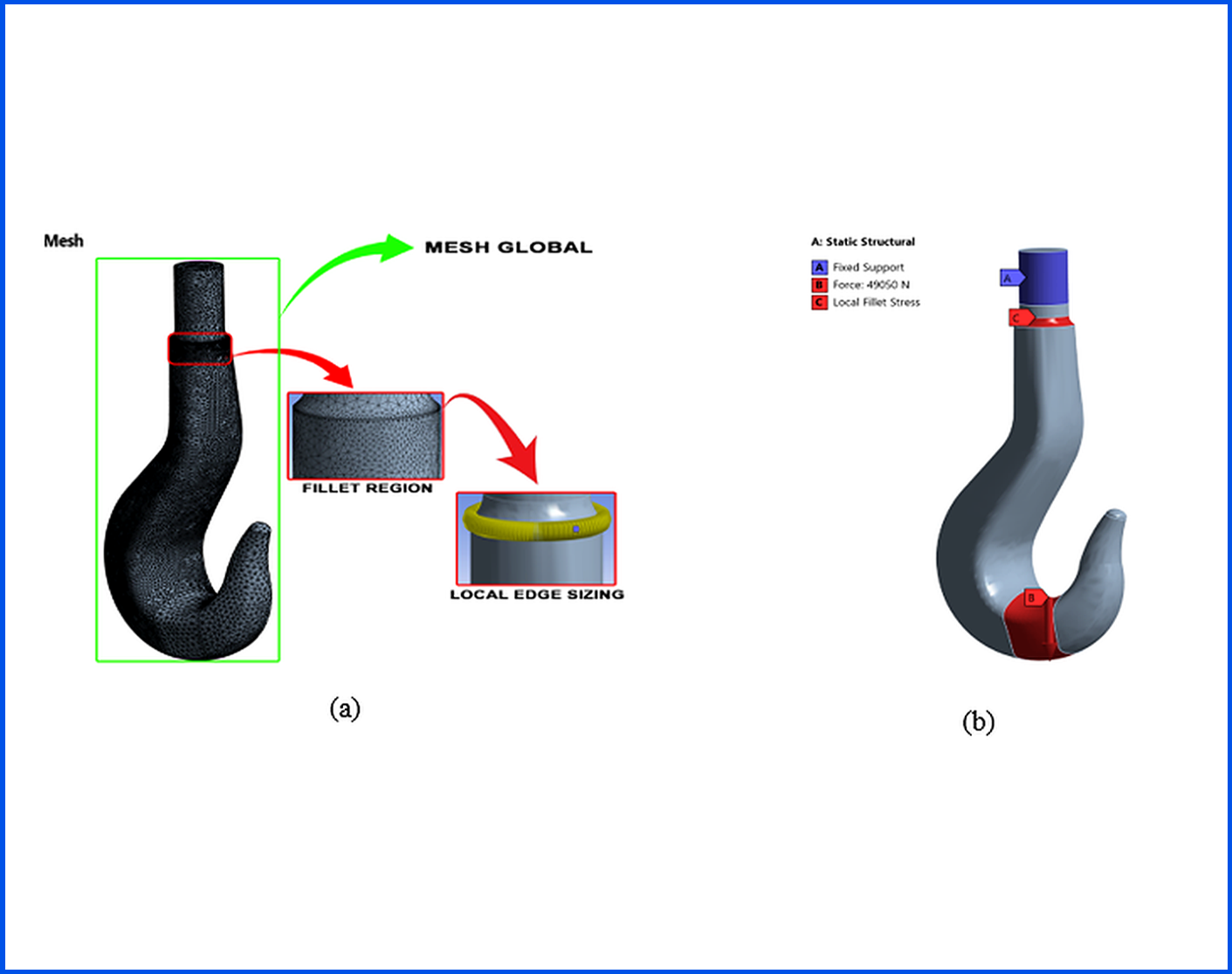
Geometric modifications of lifting hooks are generally evaluated based on changes in stress at the modified region; however, a reduction in local stress does not necessarily produce a corresponding change in the global response of the hook. This study evaluates the effect of fillet radius at the transition between the shank and hook body on the local and global structural responses. Four fillet radii, namely 5, 10, 15, and 20 mm, were analyzed using the finite element method in ANSYS Static Structural with AISI 1045 Hot Rolled steel under a static load of 49,050 N. The reliability of the model was evaluated through mesh convergence analysis and comparison with an analytical stress concentration factor approach. The results show that increasing the fillet radius from 5 to 15 mm reduced the local stress at the fillet by 15.59%, from 68.49 MPa to 57.81 MPa, whereas a further increase to 20 mm did not produce an additional reduction. In contrast, the maximum global stress occurring at the inner bowl surface changed by only 0.25%, from 138.15 to 138.49 MPa, resulting in a relatively constant factor of safety in the range of 2.383–2.389. The maximum deformation also changed by only 0.69% across the range of fillet radii. These results indicate that the fillet radius has a more pronounced effect on the local stress response than on the global structural response. Therefore, a reduction in stress at the fillet region alone is insufficient to demonstrate an improvement in the overall strength of the lifting hook, particularly when the modified region is not the location of maximum stress. Evaluation of geometric modifications in lifting hooks should therefore consider the location of critical regions and distinguish between local and global structural responses.
References
J. Wang, S. Hu, Y. Fang, and H. Guo, “Knowledge-augmented multi-modal data fusion and reasoning for automated crane lift monitoring,” Autom. Constr., vol. 183, p. 106822, Mar. 2026, doi: 10.1016/j.autcon.2026.106822.
E.-S. Habib and E. Shamso, “A validated workflow for the design and certification of below-the-hook lifting devices integrating finite element analysis and physical proof testing,” Sci. Rep., vol. 15, no. 1, p. 44058, Dec. 2025, doi: 10.1038/s41598-025-31175-y.
M. N. H. Dipu, M. H. Apu, and P. P. Chowdhury, “Identification of the effective crane hook’s cross-section by incorporating finite element method and programming language,” Heliyon, vol. 10, no. 9, p. e29918, May 2024, doi: 10.1016/j.heliyon.2024.e29918.
Institute of Solid Mechanics of the Romanian Academy, Bucharest, D. Dumitriu, M. Ionescu, Institute of Solid Mechanics of the Romanian Academy, Bucharest, C. Rugina, and Institute of Solid Mechanics of the Romanian Academy, Bucharest, “Hook crane shape design improvement for reducing the maximum stress,” Romanian J. Tech. Sci. - Appl. Mech., vol. 68, no. 1, pp. 21–44, Apr. 2023, doi: 10.59277/RJTS-AM.2023.1.02.
E. Narvydas and N. Puodžiūnienė, “CIRCUMFERENTIAL STRESS CONCENTRATION FACTORS AT THE ASYMMETRIC SHALLOW NOTCHES OF THE LIFTING HOOKS OF TRAPEZOIDAL CROSS-SECTION,” Mechanics, vol. 18, no. 2, pp. 152–157, Apr. 2012, doi: 10.5755/j01.mech.18.2.1574.
V. D. Hiep, N. X. Quynh, and T. T. Tung, “A topology optimization design of a crane hook,” Results Eng., vol. 23, p. 102492, Sep. 2024, doi: 10.1016/j.rineng.2024.102492.
The Graduate School of Natural and Applied Sciences, Necmettin Erbakan University, Konya, Türkiye, Ö. Kurt, M. Uyaner, and Department of Aeronautical Engineering, Faculty of Aeronautics and Astronautics, Necmettin Erbakan University, Konya, Türkiye, “Stress analysis of aircraft tow hook using non-destructive testing techniques and numerical simulation,” Res. Eng. Struct. Mater., 2026, doi: 10.17515/resm2026-1133me0903rs.
R. S. A. Imron, S. Pradana, and D. Rhakasywi, “Analysis of the Effect of Thermal Condition Parameters on the Strength of the Coil Lifting C-Hook Using the Finite Element Method (Case Study at PT. X),” Eduvest - J. Univers. Stud., vol. 5, no. 11, pp. 13367–13386, Nov. 2025, doi: 10.59188/eduvest.v5i11.52379.
N. A. Akeel, V. Kumar, A. B. Omran, I. Alkharusi, and N. Alanbouri, “Comparative Stress Analysis and Parametric Optimization of Crane Hooks Using Finite Element Analysis,” Eng. Technol. Appl. Sci. Res., vol. 16, no. 2, pp. 33391–33398, Apr. 2026, doi: 10.48084/etasr.16375.
W. D. Pilkey and D. F. Pilkey, Peterson’s Stress Concentration Factors, 1st ed. Wiley, 2007. doi: 10.1002/9780470211106.
G. Cadet and M. Paredes, “Convergence analysis and mesh optimization of finite element analysis related to helical springs,” Mech. Ind., vol. 25, p. 22, 2024, doi: 10.1051/meca/2024018.
Celik et al., “Procedure for Estimation and Reporting of Uncertainty Due to Discretization in CFD Applications,” J. Fluids Eng., vol. 130, no. 7, p. 078001, 2008, doi: 10.1115/1.2960953.
D. Molnár, M. Blatnický, and J. Dižo, “DESIGN AND STRENGTH ANALYSIS OF A CRANE HOOK WITH A 500 KG LIFTING CAPACITY,” Perners Contacts, vol. 16, no. 2, Dec. 2021, doi: 10.46585/pc.2021.2.1702.
Y. S. Hadiwidodo, R. G. Permana, and Handayanu, “Strength Analysis of Crane Hook Structure with Trapezoidal Cross-Section Based on Rigging Configuration on the Upper Deck Lifting Process,” IOP Conf. Ser. Earth Environ. Sci., vol. 1166, no. 1, p. 012033, May 2023, doi: 10.1088/1755-1315/1166/1/012033.
Downloads
Published
Issue
Section
License
Copyright (c) 2026 Adriansyah Adriansyah, Khaidir Khaidir, Muhammad Riza, Chiena L. Palconite, Risal Abu

This work is licensed under a Creative Commons Attribution 4.0 International License.